
Radiators cold at the bottom but warm at the top. A boiler that bangs and gurgles. Some rooms that never get properly warm no matter how long the heating runs. These are the classic signs of a central heating system full of sludge, and bleeding the radiators will not fix any of them.
What clears it is a powerflush. Here is how to tell whether your system needs one, what it involves, and what it costs in St Albans.
Key points
- Radiators cold at the bottom and warm at the top are the most reliable sign of sludge.
- Bleeding radiators will not clear sludge. A powerflush will.
- A powerflush in St Albans typically costs £400 to £700, depending on how many radiators you have.
- Fitting a magnetic filter at the same time stops the problem coming back.
What sludge actually is
Inside your radiators and pipework, water and steel react over time and produce iron oxide. It is essentially rust, suspended in the system water as a thick black sludge. Gravity pulls it to the lowest points, which is why the bottom of a radiator goes cold first while the top stays hot.
As it builds up it restricts flow, forces the pump and boiler to work harder, and eventually blocks the heat exchanger. That last one is expensive, which is why this is worth dealing with early.
Six signs your system needs flushing
- Cold spots at the bottom of radiators. The most reliable single indicator.
- Some radiators never heat up while others are fine, usually the ones furthest from the boiler.
- Banging or kettling from the boiler. Restricted flow makes water boil locally against the heat exchanger.
- Dirty black water when you bleed a radiator. Clear water is healthy. Black water is sludge.
- The system takes a long time to warm up from cold compared with a year or two ago.
- Repeated pump failures. Pumps forced to push sludge wear out early.
One of these on its own might be something else. Three or more together and it is almost certainly sludge.
Powerflush or chemical flush?
These are not the same thing and the difference matters when you compare quotes.
| Chemical flush | Powerflush | |
|---|---|---|
| How it works | Cleaner circulated by your own pump | High-flow pumping unit with magnetic capture |
| Time on site | 2 to 3 hours | 4 to 8 hours |
| Typical cost | £150 to £300 | £400 to £700 |
| Best for | Light build-up, newer systems | Established sludge, cold spots, older systems |
If a quote looks cheap for a “powerflush”, check which one is actually being carried out. A chemical flush on a badly sludged system will not clear it.
What a powerflush costs in St Albans
Price is driven mainly by radiator count. As a guide, expect around £400 to £500 for a typical three bedroom house with eight to ten radiators, and £550 to £700 for larger properties with twelve or more. Systems that are severely blocked occasionally need individual radiators removing and flushing separately, which adds time.
A magnetic filter should be fitted at the same time if you do not already have one. It catches new debris continuously and is the reason the problem does not simply return.
What happens on the day
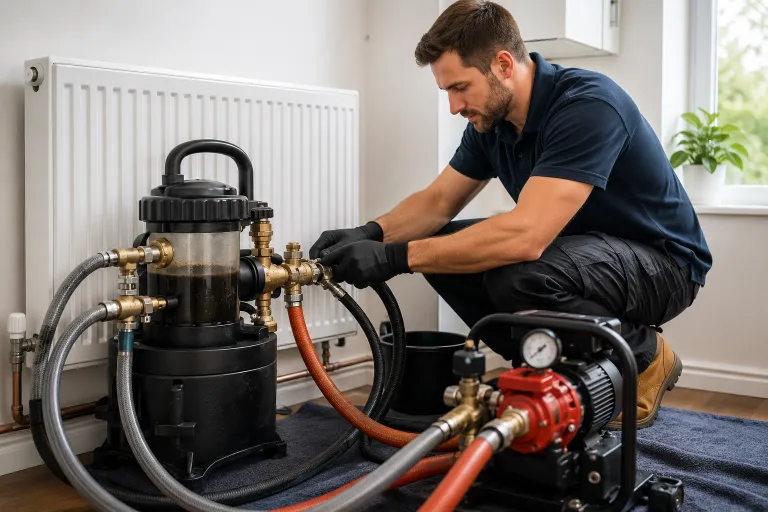
We connect a powerflushing unit across the system, then circulate cleaning chemicals at high flow while reversing direction repeatedly to lift deposits that settled flow would leave behind. Each radiator is worked individually, and a magnetic filter on the flushing unit captures the debris as it comes out.
Once the water runs clear, the system is neutralised, refilled and dosed with corrosion inhibitor. We then balance the radiators so they all heat evenly, which is a step that gets skipped surprisingly often.
Most homes take four to six hours. You will need heating off during the work and it is helpful to have access to every radiator.
What to expect afterwards
Radiators heat evenly and reach temperature faster. The boiler is usually quieter. Most people find the house warms up noticeably quicker, which means the heating runs for less time to reach the same temperature.
Whether that translates into a specific percentage saving depends on how bad the system was to begin with, so treat any firm number with caution. What is reliable is that a clean system puts less strain on the boiler and pump, and both last longer as a result.
Keeping it clean
- Fit a magnetic filter if you do not have one. It is the single most effective preventative measure.
- Have the filter emptied annually as part of your boiler service.
- Keep inhibitor topped up. It depletes over time and after any system drain-down.
- Run the heating briefly in summer, around fifteen minutes monthly, to stop the pump seizing.
Done consistently, a flushed system should stay clear for eight to ten years. The Chartered Institute of Plumbing and Heating Engineering publishes best-practice guidance on system water quality if you want the technical detail.
Is it worth it on an old system?
Sometimes not. If radiators are corroded to the point of leaking, flushing can expose weaknesses and cause pinholes to open up. On a system that old, replacing the radiators or the whole heating system may be the better use of the money. We will tell you honestly which situation you are in before booking the work.
Book a powerflush in St Albans
We powerflush systems across St Albans, Harpenden, Hatfield, Watford, Welwyn Garden City, Redbourn and London Colney. We will check the system first and tell you whether a full powerflush is genuinely needed or whether a chemical clean will do the job for less.
Frequently asked questions
How much does a powerflush cost in St Albans?
Around £400 to £500 for a typical three bedroom house with eight to ten radiators, and £550 to £700 for larger homes with twelve or more.
How long does a powerflush take?
Most homes take four to six hours, and the heating needs to be off while the work is done.
What is the difference between a powerflush and a chemical flush?
A chemical flush circulates cleaner using your own pump and suits light build-up on newer systems. A powerflush uses a high-flow unit with magnetic capture and is the right choice for established sludge and cold spots.
How long does a powerflush last?
With a magnetic filter, the filter emptied at each annual service and inhibitor kept topped up, a flushed system should stay clear for eight to ten years.

Comments are closed