The heating comes on for the first time in autumn and one radiator stays stone cold. Or the top is hot and the bottom is cold. Or the upstairs rooms are toasty while the lounge never warms up. Radiators not heating up is one of the most common reasons people call us once the weather turns, and the frustrating part is that each symptom has a different cause.
The useful part is that the symptom usually tells you which. This guide matches what your radiator is doing to the most likely cause, shows you what you can safely fix yourself, and explains when it is time to call a heating engineer.
Key points
- Cold at the top and warm at the bottom means trapped air. Bleeding the radiator usually fixes it.
- Cold at the bottom and warm at the top means sludge. Bleeding will not help.
- One radiator cold all over is often a stuck thermostatic valve pin.
- Radiators far from the boiler staying cool usually means the system needs balancing.
- If every radiator is cold, the problem is at the boiler, the controls or the system pressure.
Start with the symptom
Turn the heating on, give it twenty minutes, then carefully feel each radiator from top to bottom and side to side. Then use this table.
| What you notice | Most likely cause | Can you fix it? |
|---|---|---|
| Cold at the top, warm at the bottom | Air trapped in the radiator | Yes, by bleeding it |
| One radiator cold all over | Stuck thermostatic valve pin, or a closed valve | Often |
| Radiators furthest from the boiler only lukewarm | System out of balance | Sometimes |
| Cold at the bottom, warm at the top | Sludge and debris | No, needs flushing |
| Every radiator cold | Boiler, controls, pressure or pump | Check the basics first |
Cold at the top: bleed the radiator
Air rises, so when it gets into the heating system it collects at the top of the radiator and stops hot water filling it. You may also hear gurgling. Letting the air out is called bleeding, and it is a five minute job.
- Turn the heating off and let the radiators cool. Bleeding a hot radiator can spray scalding water.
- Find the bleed valve, a small square or slotted screw at one top corner of the radiator. You need a radiator key or, on some valves, a flat screwdriver.
- Hold a cloth under the valve and turn the key about a quarter turn anticlockwise. You will hear a hiss as the air escapes.
- Close the valve as soon as water appears in a steady dribble rather than spitting.
- Check the boiler pressure. Bleeding lets pressure out of the system. If the gauge has dropped below the minimum shown in your boiler manual, top it up. Our guide to a boiler losing pressure shows you how.
If you are bleeding several radiators, Viessmann suggests starting with the one nearest the boiler and working outwards.
However, if the same radiator needs bleeding every few weeks, air is getting into the system from somewhere, and that is worth getting checked.

One radiator cold all over: check the valve
First, make the obvious checks. Is the thermostatic radiator valve (TRV) turned up? Has someone closed the lockshield valve at the other end, perhaps while decorating?
If both are open and the radiator is still cold, the TRV pin may be stuck. This is because TRVs often stick after a summer of not moving.
- Turn the TRV to its highest setting, then unscrew or unclip the head. You will see a small metal pin.
- Press the pin gently. It should move in and spring back out.
- If it is stuck down, tap it lightly or wiggle it free. Gentle pressure only, as forcing it can damage the valve.
- Refit the head and give the radiator time to warm up.
If the pin will not free up, or the valve weeps when you touch it, the valve needs replacing. That is a small job for a heating engineer and usually means draining down part of the system.
Some radiators cooler than others: balancing
In short, hot water takes the easiest route. In an unbalanced system, the radiators closest to the boiler get most of the flow and the ones at the far end of the house only get a trickle. You will notice it as some rooms warming quickly while others never get there.
Balancing means adjusting the lockshield valve on each radiator, the plain capped valve opposite the TRV, so that every radiator gets its share. A rough DIY approach is to close the lockshield slightly, around a quarter turn, on the radiators that heat up fastest, and leave the slow ones fully open. Doing it properly involves measuring the temperature drop across each radiator and adjusting them one by one, which is fiddly and takes time.
Balancing is something we often do when fitting new radiators, and our radiator installation page explains what that work involves.
Cold at the bottom: sludge
If the top of the radiator is warm and the bottom is cold, the problem is not air. Over the years, corrosion inside the steel radiators produces a black sludge that sinks and settles along the bottom, blocking the flow. As a result, bleeding will not shift it, and it often affects several radiators at once.
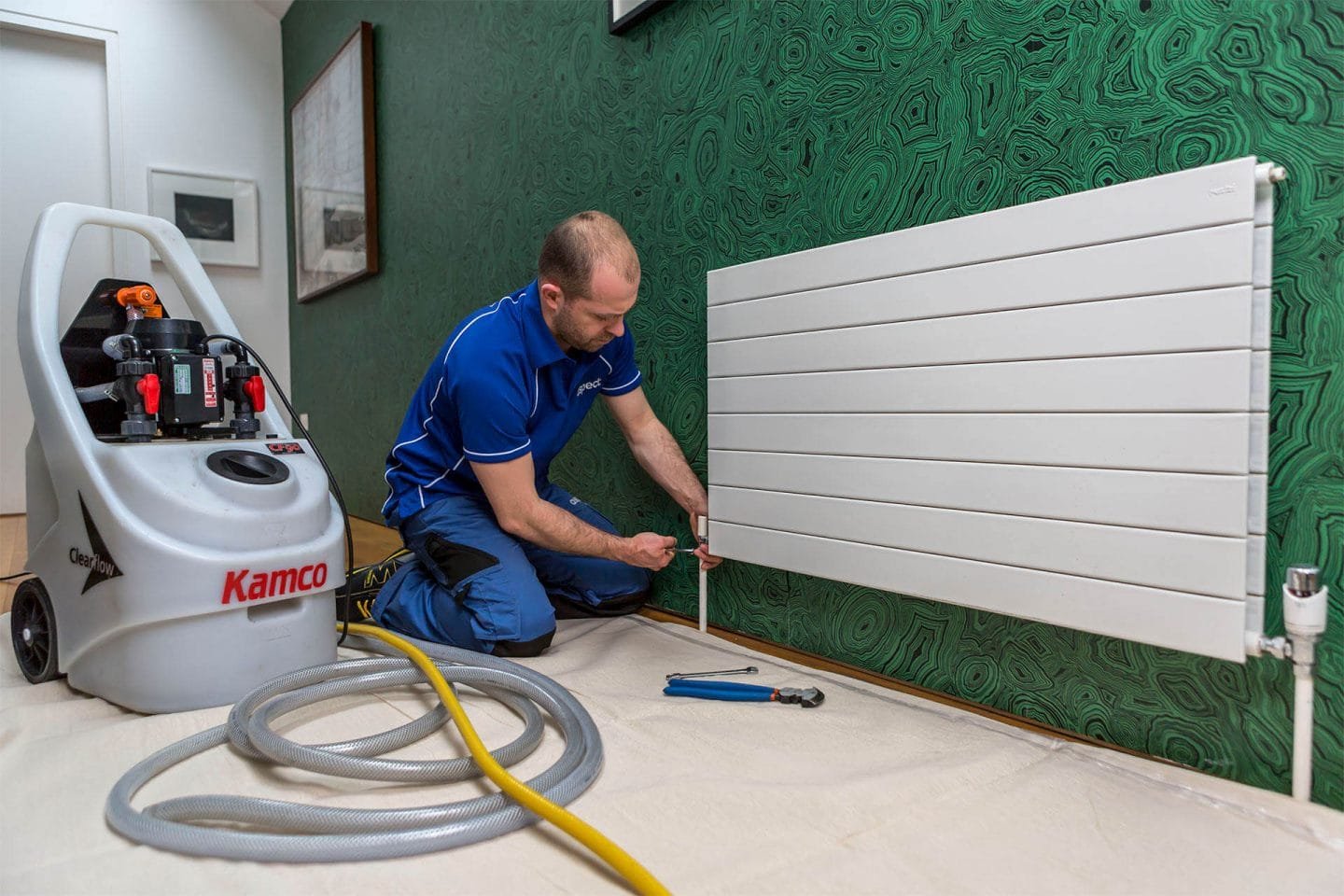
We have covered this in detail in our guide on whether your central heating needs a powerflush, including the other warning signs and what the process involves. A single badly affected radiator can sometimes be removed and flushed out on its own. If several radiators are cold at the bottom, a full central heating powerflush is usually the answer.
All radiators cold
However, if none of the radiators are heating up, the radiators themselves are not the problem. Work through these before calling anyone:
- Thermostat: is it set above the current room temperature, and are the batteries working?
- Timer or programmer: is the heating actually scheduled to be on? Power cuts and clock changes can reset it.
- Boiler mode: some combi boilers have a summer or hot water only mode. Check it has not been left on.
- Pressure: on a combi or system boiler, check the gauge is within the range shown in your boiler manual. Most sit between 1 and 1.5 bar when cold.
- Fault code: if the boiler display shows one, note it down. In freezing weather, check for a frozen condensate pipe.
If you have hot water but no heating at all, the fault is often a part that directs hot water between the taps and the radiators, such as a diverter valve on a combi or a motorised zone valve on a system boiler. A failed pump can cause the same symptom. These are boiler repair jobs, and our guide to common boiler faults explains them in more detail.
When to call a heating engineer
Call us if:
- Radiators are cold at the bottom, or several are affected.
- The same radiator keeps filling with air.
- A valve is leaking, seized or will not turn.
- Every radiator is cold and the basic checks above have not helped.
- The boiler is showing a fault code that a reset will not clear.
Anything inside the boiler casing must be handled by a Gas Safe registered engineer. An annual boiler service before winter is also the easiest way to catch small heating problems before they leave you with cold rooms.
Radiators still not heating up?
Our heating engineers diagnose cold radiators, balance systems, replace valves and flush out sludge. We cover St Albans, Harpenden, Hatfield, Watford, Welwyn Garden City, Redbourn and London Colney.
Frequently asked questions
Why is my radiator cold at the top?
Air is trapped inside it. Air rises and collects at the top of the radiator, stopping hot water filling it. Bleeding the radiator with a radiator key lets the air out and usually fixes it.
Why is my radiator cold at the bottom?
Sludge has built up inside it. Corrosion over time creates a heavy deposit that settles along the bottom and blocks the flow. Bleeding will not help. The radiator or the whole system needs flushing.
Why is only one radiator not heating up?
The most common causes are a stuck thermostatic valve pin, a closed lockshield valve or air trapped in that radiator. Check the valves are open and the TRV pin moves freely, then try bleeding it.
Do I need to check the boiler pressure after bleeding radiators?
Yes. Bleeding lets pressure out of the system. If the gauge on a combi or system boiler drops below the minimum pressure stated in your boiler manual, top it up using the filling loop.
What does balancing radiators mean?
Adjusting the lockshield valve on each radiator so hot water is shared evenly around the house. Without it, radiators nearest the boiler get hot while those furthest away stay lukewarm.

Comments are closed