
If you let a house or flat with a gas supply, one job comes round every year without fail: the landlord gas safety check. Most landlords call the paperwork a CP12 or a landlord gas safety certificate. The law calls it a Landlord Gas Safety Record. Whatever you call it, getting it wrong is one of the more serious compliance mistakes a landlord can make.
We carry out landlord gas safety checks across St Albans and the wider Hertfordshire area, and the same questions come up again and again. When is it due? Can I do it early? What happens if the boiler fails? This guide answers them in plain English, with links to the official guidance so you can check anything for yourself.
Key points
- Every gas appliance and flue you provide in a rented property must be safety checked every 12 months by a Gas Safe registered engineer.
- Existing tenants must get a copy of the record within 28 days of the check. New tenants must get one at the start of their tenancy.
- You can have the check done 10 to 12 months after the last one without losing your original renewal date.
- In England, landlords must provide a carbon monoxide alarm in a room used as living accommodation containing a fixed combustion appliance, excluding a gas cooker.
What is a landlord gas safety certificate?
It is the written record of an annual safety check on the gas appliances and flues in a rented property. The legal duty comes from the Gas Safety (Installation and Use) Regulations 1998, and the Health and Safety Executive publishes the official guidance for landlords.
“CP12” was the name of the old CORGI form, and it has stuck. You will hear CP12, gas safety certificate, LGSR and landlord gas safety record used for the same thing. As the Gas Safe Register explains, the only document the law actually requires is the Landlord Gas Safety Record. It lists the checks the engineer carried out and whether each appliance is safe to use.
What the law requires of landlords
The Gas Safe Register’s landlord guidance sets the duties out clearly. In summary, you must:
- Have every gas appliance and flue you provide checked every year by a Gas Safe registered engineer.
- Keep the gas pipework, appliances, chimneys and flues in a safe condition, following the manufacturer’s service intervals, or servicing annually if there are none.
- Give existing tenants a copy of the record within 28 days of the check.
- Give new tenants a copy at the start of their tenancy. For lets of under 28 days, display a copy clearly inside the property.
- Keep each record until two further checks have been carried out.
Only a Gas Safe registered engineer can do the check. Before anyone starts, ask to see their Gas Safe ID card and check the back of it shows they are qualified for the appliances in your property. You can confirm any engineer on the Gas Safe Register, including us.
Appliances your tenant owns
If a tenant brings their own gas cooker or fire, you are not responsible for checking that appliance. You do remain responsible for any flue it connects to, unless the flue serves only the tenant’s appliance.
If a tenant will not give access
Your tenancy agreement should allow access for the check. If a tenant still refuses, you need to show you took every reasonable step: repeated attempts, written notice explaining why the check matters, and a record of everything you did. The regulations do not give you power to force entry or cut off the gas, so take legal advice if it gets that far.
What a gas safety certificate check covers
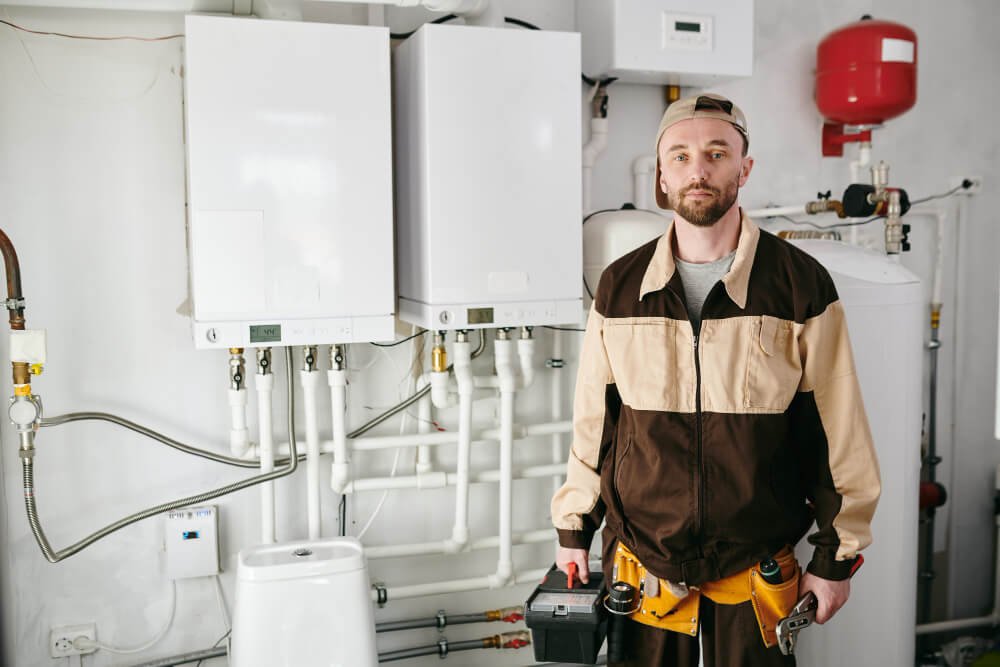
On the day, the engineer works through each landlord-owned gas appliance in the property, usually the boiler, a gas hob or cooker and any gas fire. For each one, a landlord safety check typically includes:
- Checking the appliance is burning correctly and safely.
- Testing the flue or chimney to make sure combustion gases are being carried away and not spilling into the room.
- Checking there is enough ventilation for the appliance.
- Confirming the safety devices work, so the gas shuts off if something goes wrong.
- A visual check of the appliance’s condition and installation.
The annual check does not formally cover the installation pipework, but the Gas Safe Register recommends you ask for a tightness test and a visual inspection of the pipework at the same time, so it is worth mentioning when you book.
How long it takes depends on the number of appliances. A typical flat with a combi boiler and a gas hob is a short visit. A larger house with several appliances takes longer.
Gas safety certificate renewals and record keeping
Renewal dates are where most landlords come unstuck, especially with several properties.
The renewal window works a lot like a car MOT. If the new check is carried out between 10 and 12 months after the last one, your expiry date does not change, so you do not lose any months. For example, a certificate due on 1 December can be renewed any time from 1 October and still run to the following 1 December. If the check is done earlier than 10 months, the new 12 month period starts from the date of that check instead.
A few habits make this easy:
- Book the check around the 10 month mark, so you have time to sort out any repairs before the deadline.
- Send the tenant their copy the same week rather than waiting for the 28 day limit.
- Keep digital copies of every record, filed by property, so you can show at least the last two.
Carbon monoxide alarms
Separate from the gas safety check, the Smoke and Carbon Monoxide Alarm (Amendment) Regulations 2022 came into force in England on 1 October 2022. Landlords must make sure a carbon monoxide alarm is fitted in any room used as living accommodation that contains a fixed combustion appliance, such as a gas boiler. Gas cookers are excluded. Alarms must be repaired or replaced once you are told they are faulty, as set out in the GOV.UK guidance for landlords and tenants.
Rules differ in Scotland and Northern Ireland, so check the local requirements if you let property outside England.
If you or your tenant smell gas
Do not use electrical switches or naked flames. Open doors and windows, turn the gas off at the meter if it is safe to reach, leave the property and call the National Gas Emergency Service on 0800 111 999. The line is free and staffed 24 hours a day.
What happens if an appliance fails
If the engineer finds a problem, they note it on the safety record along with how serious it is. Under the gas industry’s unsafe situations procedure, the engineer will turn off and label an appliance that is a danger to life, with your permission or your tenant’s, and nobody should use it until it is repaired. For lower risk issues, the engineer records advice on what needs doing.
A failed appliance does not give you a valid record for that appliance. You need to have it repaired, or removed, and rechecked. If it is the boiler, that might mean a boiler repair or, for an old unit, a replacement boiler. If the engineer suspects a leak on the supply, gas leak detection is the next step.
This is the main reason to book early. A failed check at month 10 gives you time to fix it. A failed check the day before the deadline leaves your tenant without heating and you out of compliance.
Combining the check with a boiler service
A safety check and a service are not the same thing. The safety check confirms the appliances are safe on the day. A boiler service goes further: it cleans and inspects the working parts so the boiler keeps running reliably, and most manufacturers require one every year to keep the warranty valid.
Because both are annual, it makes sense to do them together. We can carry out the landlord gas safety check and the boiler service in one visit, so your tenant only needs to be home once and you have one date to remember.
Need a landlord gas safety certificate in St Albans?
Our Gas Safe registered engineers carry out landlord gas safety checks and issue the record on completion. We cover St Albans, Harpenden, Hatfield, Watford, Welwyn Garden City, Redbourn and London Colney.
Frequently asked questions
How often do landlords need a gas safety certificate?
Every 12 months. Each gas appliance and flue you provide must be checked annually by a Gas Safe registered engineer, and the tenant must receive a copy of the record.
Is a CP12 the same as a gas safety certificate?
Yes. CP12 is the name of an old form that stuck. The document the law requires is the Landlord Gas Safety Record, which is what people mean by a CP12 or landlord gas safety certificate.
Can I renew my gas safety certificate early?
Yes. A check carried out 10 to 12 months after the last one keeps your original renewal date. If it is done earlier than that, the 12 month period starts again from the new check.
How long must landlords keep gas safety records?
Keep each record until two further checks have been carried out. In practice, keeping digital copies of every record for each property is the simplest approach.
Do landlords have to check gas appliances owned by the tenant?
No. You are not responsible for a tenant’s own appliance, but you are still responsible for any flue it connects to, unless that flue serves only the tenant’s appliance.
Can a landlord gas safety check be done with a boiler service?
Yes, and it is usually the sensible option. Both are annual, so doing them in one visit saves your tenant a second appointment. We can do both together.

Comments are closed